Liber III · Black & White Magic
Glossary of Magic: Key Terms from Apotropaic to Theurgy
A glossary of magic terms: goetia, theurgy, maleficium, amulet and talisman, sigil, invocation and evocation, sympathetic magic and the words scholars use.

The vocabulary of magic is old, borrowed from Greek, Latin, Hebrew, Arabic and the European vernaculars, and many of its words have changed meaning over the centuries. This glossary explains the key terms a reader meets in the history of magic, from ancient goeteia and theurgy to the amulets, sigils and evocations of the grimoires and the analytical language of modern scholars. Each entry gives the usual meaning and, where it matters, how the word's sense has shifted. For a narrative overview, begin with what is magic?.
Words for Magic and Its Practitioners§
Magic. From Greek mageia, the art of the magoi, the Persian priestly caste described in the Magi. In Greek usage it soon came to mean foreign or illicit ritual power. Today the word covers a wide range of practices believed to influence the world through hidden forces, spirits or symbolic action.
Magick. An older spelling revived by Aleister Crowley in the early twentieth century to distinguish his spiritual and ritual system from stage conjuring. It is now common among occultists, especially in Thelema and chaos magick.
Goetia. From Greek goeteia, originally the lamenting, spell-singing art of the goes, a word that carried overtones of fraud and danger. Christian writers used it for demonic magic, and the seventeenth-century Lemegeton gave the name to its catalogue of the 72 spirits of Solomon.
Theurgy. "Divine work": the ritual practices of late Neoplatonists such as Iamblichus, intended to unite the soul with the gods, contrasted by them with base goeteia. See Neoplatonism and theurgy.
Maleficium. Latin for "evil deed", the legal and theological term for harm caused by magic, at the heart of the witch trials; see maleficium and curses.
Necromancy and nigromancy. Necromancy originally meant divination by consulting the dead, as in the story of the Witch of Endor. In medieval Latin the spelling nigromantia, "black divination", made it a name for demonic ritual magic generally, the subject of necromancy in the Middle Ages.
Sorcery, witchcraft and wizardry. In English usage sorcery usually denotes learned or deliberate spell-working, while witchcraft has meant both harmful magic attributed to witches and, since the twentieth century, the religion of modern witches. "Wizard" originally meant a wise man; "warlock" comes from an Old English word for an oath-breaker.
Cunning folk. Commercial folk magicians of early modern Britain who healed, found lost goods and countered witchcraft, described in folk magic.
Grimoire. A book of magical instructions; the French word is related to grammaire, "grammar", a learned book in Latin. The classic grimoires are surveyed in the grimoire revival.
Kinds and Categories of Magic§
Natural magic. The use of the hidden, or "occult", properties of plants, stones and stars without the aid of spirits, defended by Renaissance authors as a part of natural philosophy; see natural magic.
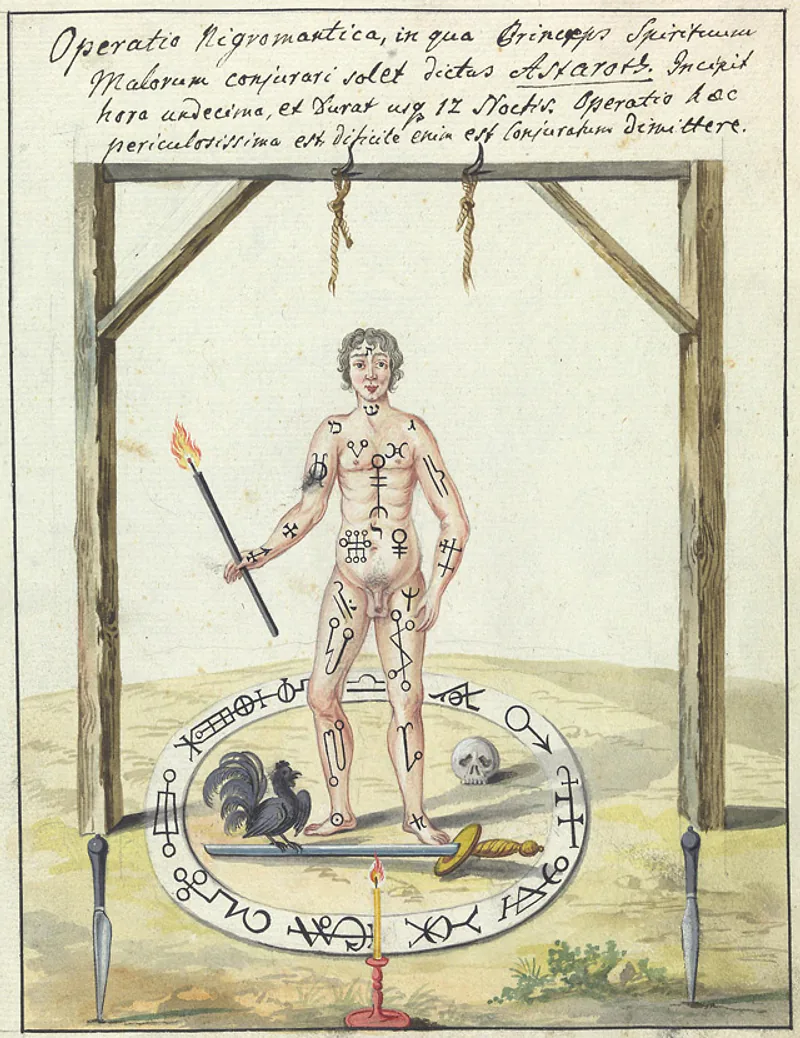
Ceremonial or high magic. Learned ritual magic using elaborate preparations, divine names, circles and consecrated tools, as distinct from the "low" magic of everyday charms; see what is ceremonial magic?.
Black and white magic. Labels for harmful or demonic magic and for beneficial or licit magic respectively. Both terms are polemical and imprecise; their histories are traced in black magic and white magic.
Astral or image magic. Magic using the power of the stars, especially by making images or talismans at astrologically chosen moments, as in the Picatrix; see astral magic.
Sympathetic magic. James Frazer's term, in The Golden Bough, for magic based on the principle that like produces like ("homoeopathic" or imitative magic) or that things once in contact continue to act on each other ("contagious" magic). Modern scholars use the terms descriptively but reject Frazer's evolutionary scheme.
Left-hand path and right-hand path. Terms adapted from Indian tantra by Helena Blavatsky and later occultists to distinguish antinomian, self-deifying currents from those seeking union with the divine; see the left-hand path.
Objects, Signs and Tools§
Amulet. An object worn or placed to protect its owner, usually against evil, illness or the evil eye.
Talisman. An object made, often under particular astrological conditions and inscribed with signs or names, to attract a specific power or benefit. The contrast with the amulet is a modern convention rather than an ancient rule; both are explored in amulets and talismans.
Charm. A formula of words, sometimes written and worn, used to heal or protect; see healing charms.
Sigil. A sign that represents a spirit or an intention. In the grimoires sigils are the seals of spirits; in modern chaos magick a sigil is a monogram made from a written statement of desire. See sigils.
Pentacle. In the Solomonic tradition, a disc or parchment bearing divine names and figures that protects the magician and commands spirits; see Solomonic pentacles. In modern Wicca the word denotes an altar disc bearing a pentagram.
Magic circle and triangle. The circle is the protected space in which the magician stands; in goetic ritual a triangle outside it marks where a spirit is expected to appear.
Apotropaic. "Turning away" evil: describes anything intended to avert harm, from eye beads to the witch marks cut into old buildings.
Kamea. A magic square associated with a planet, popularised by Agrippa; see magic squares.
Spirits and Powers§
Daimon and demon. Greek daimon meant an intermediary spirit, good or bad; Christian usage narrowed "demon" to fallen angels. See demonology.
Familiar. A spirit, often in animal form, believed to serve a witch or magician; see the witch's familiar.
Holy Guardian Angel. In the Abramelin tradition and in Thelema, the personal angel whose "knowledge and conversation" is the central goal of the work; see the Holy Guardian Angel.
Egregore and servitor. Modern occult terms for a collective thought-form created by a group, and for an artificial spirit created by an individual to perform a task; see servitors and egregores.
Planetary intelligences and spirits. In Renaissance magic, the good and evil spirits assigned to each planet, often with sigils derived from magic squares; see planetary angels.
Methods and Ritual Acts§
Invocation and evocation. In modern ceremonial usage, invocation calls a divine power into the magician, while evocation calls a spirit to appear outside, usually in the triangle. Older texts do not always distinguish the words so sharply.
Conjuration. The solemn command of a spirit by divine names, the core of grimoire magic. In later English the word also came to mean stage illusion.
Banishing. A ritual for clearing a space of unwanted influences before or after a working, such as the Golden Dawn's Lesser Banishing Ritual of the Pentagram.
Consecration. The ritual setting apart of a tool, place or person for sacred or magical use.
Correspondences. Systems linking planets, metals, colours, plants, angels and other things in sympathetic chains, the theoretical backbone of Western magic; see correspondences.
Defixio. A Latin binding curse inscribed on lead; see curse tablets.
Historiola. A charm built around a short sacred story whose outcome is invoked again in the present.
Pact. An agreement with a demon, real or alleged, that theologians believed underlay all demonic magic.
Terms Used by Scholars§
Occultism. A nineteenth-century French coinage, popularised by Éliphas Lévi and his successors, for the modern study and practice of hidden sciences; see what is occultism?.
Western esotericism. The academic field, shaped by Antoine Faivre and Wouter Hanegraaff, that studies Hermetic, Kabbalistic, alchemical, magical and related currents in European culture; see what is Western esotericism?.
Disenchantment. Max Weber's phrase for the modern loss of belief in mysterious incalculable forces; see disenchantment and re-enchantment.
Emic and etic. Anthropological terms for describing a practice in its participants' own categories (emic) or in an outside observer's (etic). The debate over whether "magic" is a useful etic category is summarised in theories of magic.
Frequently asked questions§
What is the difference between an amulet and a talisman?§
In common modern usage an amulet protects its wearer by warding off harm, while a talisman is made, often at an astrologically chosen time, to draw a particular power or benefit. Ancient and medieval sources do not always observe the distinction, so it is best treated as a convenient convention.
What is the difference between invocation and evocation?§
In modern ceremonial magic, invocation means calling a deity or higher power into oneself, and evocation means summoning a spirit to appear outside the magician, usually in a triangle. Many older grimoires use the words interchangeably.
Why do some people spell it "magick"?§
Aleister Crowley revived the old spelling to separate ritual and spiritual magic from stage conjuring. It is widely used in Thelema, chaos magick and parts of modern Paganism, while academic writers usually keep "magic".
Is theurgy a kind of magic?§
The Neoplatonists who practised theurgy insisted that it was not, contrasting it with goeteia. Many modern historians nonetheless treat it as part of the history of magic because of its use of ritual, symbols and divine names.
Sources and further reading§
- Magic in the Middle Ages — Richard Kieckhefer, 1989
- Dictionary of Gnosis & Western Esotericism — Wouter J. Hanegraaff, 2005
- Magic: A History — Chris Gosden, 2020
- The Golden Bough — James George Frazer, 1890
- Defining Magic: A Reader — Bernd-Christian Otto & Michael Stausberg, 2013